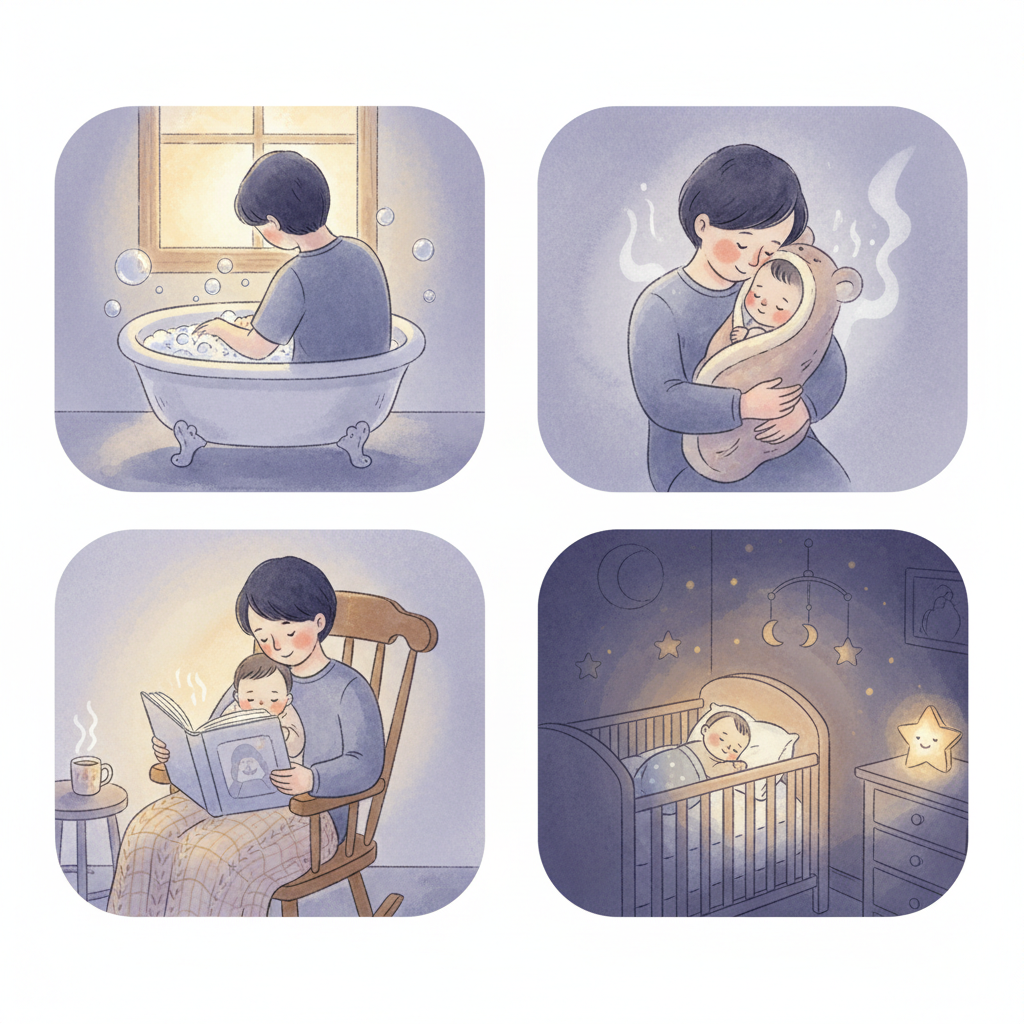
Bedtime Routine: Building Your Baby's Sleep Anchor
A consistent 20-minute routine signals baby's brain that sleep is coming — and makes bedtime easier every night.
A bedtime routine is one of the most powerful tools in a parent's toolkit. Babies as young as 6–8 weeks begin to respond to predictable pre-sleep sequences. By 3–4 months, a consistent routine can dramatically improve how quickly baby falls asleep and how long they stay asleep.
Why Routines Work
Baby's brain doesn't yet understand time — but it understands sequence. When the same steps happen in the same order every night, baby's body begins releasing melatonin (the sleep hormone) in anticipation, before you even put them down.
The 4-Step Bedtime Formula
Warm bath (5–10 minutes)
A warm bath followed by cooling air mimics the natural body temperature drop that triggers sleep. It doesn't need to be a full wash — even a quick warm soak works beautifully.
Gentle massage and fresh pajamas (5 minutes)
A slow, rhythmic massage with a fragrance-free lotion signals deep relaxation. Dim the lights during dressing to begin shifting the environment toward sleep.
Feed in a calm, dim space (10–15 minutes)
Whether breast or bottle, the last feed should happen in a quiet, dimly lit room. Avoid bright screens nearby.
Brief wind-down ritual (5 minutes)
A soft song, a short story, or gentle rocking while saying goodnight to familiar things in the room ("goodnight lamp, goodnight bear") helps baby transition from alert to drowsy.
Timing Matters
If baby regularly takes longer than 20–30 minutes to fall asleep, bedtime may be too early. Try pushing it 15 minutes later every few days until you find the sweet spot.
Don't skip the routine on busy nights — even a shortened 10-minute version of the same steps is far more effective than no routine at all.
Based on guidance from the American Academy of Pediatrics, Mayo Clinic, and CDC. Always consult your healthcare provider for personalized medical advice.
Track every moment with Miray
Log feeds, sleep & growth in seconds — free to start.
